
Understanding whisky labels for beginners

If you’re new to the world of whisky, then we can guess how overwhelming it is for you trying to read the label (we’ve all been there).
A whisky label tells us a lot about the production, where it’s from, and how strong it is. But with a number here and a region there, it can all feel a bit too much to process.
Here’s the good news: you don’t need to memorise a glossary. Our guide will help you focus on the most important details so you can pick up a dram, decide whether it’s worth buying, and block out the rest.
The label is basically a cheat sheet if you know what to look for. Let us show you what we mean.
What’s included on a whisky label?
A whisky label covers two main things:
- The legal stuff (ABV, production info, etc.)
- Tasting information (notable flavours and tasting notes)
On most whiskies, you’ll find that this information is spread across the front of the bottle (also known as the headline info) and the back (where the selling points are mentioned).
The headline details will include things you need to know, such as the distillery name, whisky type/category, age statement, country, ABV, and volume – all the basic stuff.
The back of the label is where the actual description appears. You’ll find an insight into the type of cask it came from, tasting notes, and whisky terms like ‘peated’ and ‘matured’.
The fine print is mostly spotted by the experienced eye; it can tell you whether the whisky was bottled by the distiller or an independent bottler, which changes the style and language used on the label.
Quick tip
If you’re new to whisky, it’s best to start by reading the label information in this order:
- Type (single malt, blend, bourbon, rye…)
- ABV
- Age statement (if any)
- Cask mentions
- Any clear smoky/peated wording
We’ll get into each one a bit more now!
What to look for when buying a whisky
Brand vs distillery
The first thing to check is the brand or distillery name on the bottle. These are often used interchangeably, which can confuse those new to whisky.
A distillery is the place where the spirit is made, while a brand is the name on the label that markets and sells the whisky. Sometimes the brand and the distillery are the same, since many distillers bottle and sell their own whisky.
Every distiller brings their own production methods and expertise to the distillation process, so each offers a different tasting experience. The more you try whiskies from different distillers, the easier it will be to spot them by taste alone.
Important note: You’ll usually see the distillery clearly stated on single malts, while blends may lean more heavily on the brand identity. That’s because blended whiskies source their whisky from different distillers under a different brand name.
Whisky type/style
Checking the type or style of whisky is the quickest way to avoid buying something you won’t like.
If you’re planning on buying a Scotch whisky, the main ones you’ll come across are single malt, blended whisky, and sometimes single grain or blended malt. A single malt is produced at one distillery and is made from 100% malted barley.
Blended whisky is a mix of different whiskies, often including both malt and grain, and is often consistent from bottle to bottle. Outside Scotch, labels may show bourbon, rye, or Irish whisky, each with its own flavour profile and production method.
Age statements: what the number really means
The age statement is the number that you see on the bottle.
For example, if you see the number 10 or 12 on the bottle, it tells you the age of the youngest whisky in the bottle, not the average age or the oldest. A lot of people get hung up on age, thinking that older means better.
However, some younger whiskies taste fresh and full of flavour, while some older whiskies can become heavily oak-driven. The bottom line? It’s more about your individual preference, not the number on the bottle.
You’ll also see bottles with no age statement, also known as NAS whiskies. These are typically blends which feature a range of young and older whiskies, and the distiller has chosen not to include the age, focusing on consistency rather than tying it to a number.
Important note: Scottish law states that a spirit is only a whisky if it’s been matured for 3 years or more.
Cask type
The cask type is simply the type of wooden barrel the whisky has been left to mature in.
Why is it so important? Well, the wood shapes a huge portion of the whisky's flavour, so knowing the cask type helps whisky drinkers understand what flavours to expect from the bottle.
When a bottle mentions bourbon casks, it often points towards lighter sweetness and classic notes like vanilla, honey, citrus, and gentle oak. Sherry casks, on the other hand, often include notes of dried fruit, baking spice, chocolate, and nuts.
You might also see finishing terms, like port finish, wine finish, or rum finish, which usually indicate that the whisky spent a final period in that cask type to add another layer of flavour.
Single cask whiskies are matured and finished in a single cask, so you’ll often see them labelled with a specific barrel name or number.
Country and region
The country or region listed on the label can also tell us a lot about a whisky.
A Scotch whisky will most likely be distilled in Islay, Speyside, or the Highlands. All of these regions have reputations for certain flavour profiles and strong production regulations, but there’s plenty of variation.
For example, Islay is famous for smoky styles. Speyside often leans toward fruitier, sweeter styles, and the Highlands can range from light and floral to rich and robust. If the bottle is Irish whisky, you might expect a smoother, fruit-led profile, but again, there are plenty of bolder Irish styles too.
American labels like bourbon or rye typically have a stronger oak influence and a sweeter or spicier flavour profile. If you’re just starting out, try a whisky from different countries and regions to find what you like.
ABV strength
ABV strength tells you how much alcohol is in the bottle of whisky.
Many whiskies sit at 40% to 43%, which is often a comfortable starting point for beginners because the alcohol burn tends to be less intense. When you move up to 46% and above, you’re more likely to get a richer mouthfeel and bolder flavours.
Whiskies labelled as 'cask strength' are bottled at a much higher strength, closer to the level it was at in the cask. Most whiskies are diluted with water before they’re bottled, but if not, you can do this yourself to reduce the burn and bring out more hidden notes.
Tasting notes
Sometimes, a whisky will include some flavour descriptions to tell you what to expect from the bottle.
However, these are intended as general guidelines, as different people may pick up different notes, making the tasting experience unique to each individual. The easiest way to use tasting notes is to read them in broad flavour families.
Here’s a quick guide to help you out:
- Fruit (fresh vs dried)
- Sweet (toffee, honey, vanilla)
- Spice (cinnamon, pepper)
- Smoke (peat, bonfire)
- wood (oak, toast, tannin)
If the notes lean heavily into oak and spice, it may feel drier and more intense than something described as creamy, honeyed, or fruity.
'Filtered', 'colour', and other terms explained
Alongside the main label is often a lot of technical jargon that a whisky aficionado will take note of.
One of the main terms included on the bottle is 'chill-filtered' or 'non-chill-filtered' whisky. Chill filtration is a process some producers use to keep whisky clear when it’s cold or when water is added. Oils and fats are removed to prevent them from becoming cloudy, making it look much more appealing.
If a bottle says non-chill filtered, it means it hasn’t undergone that process. You might also see natural colour or no added colour, indicating the producer hasn’t added colouring to standardise appearance across batches.
You may also see terms like small batch, limited edition, or batch numbers, which are more for branding than for the quality of the whisky.
Whisky tasting made simple
The easiest way to find out what you like is to ditch the complicated labels and indulge in a whisky-tasting experience.
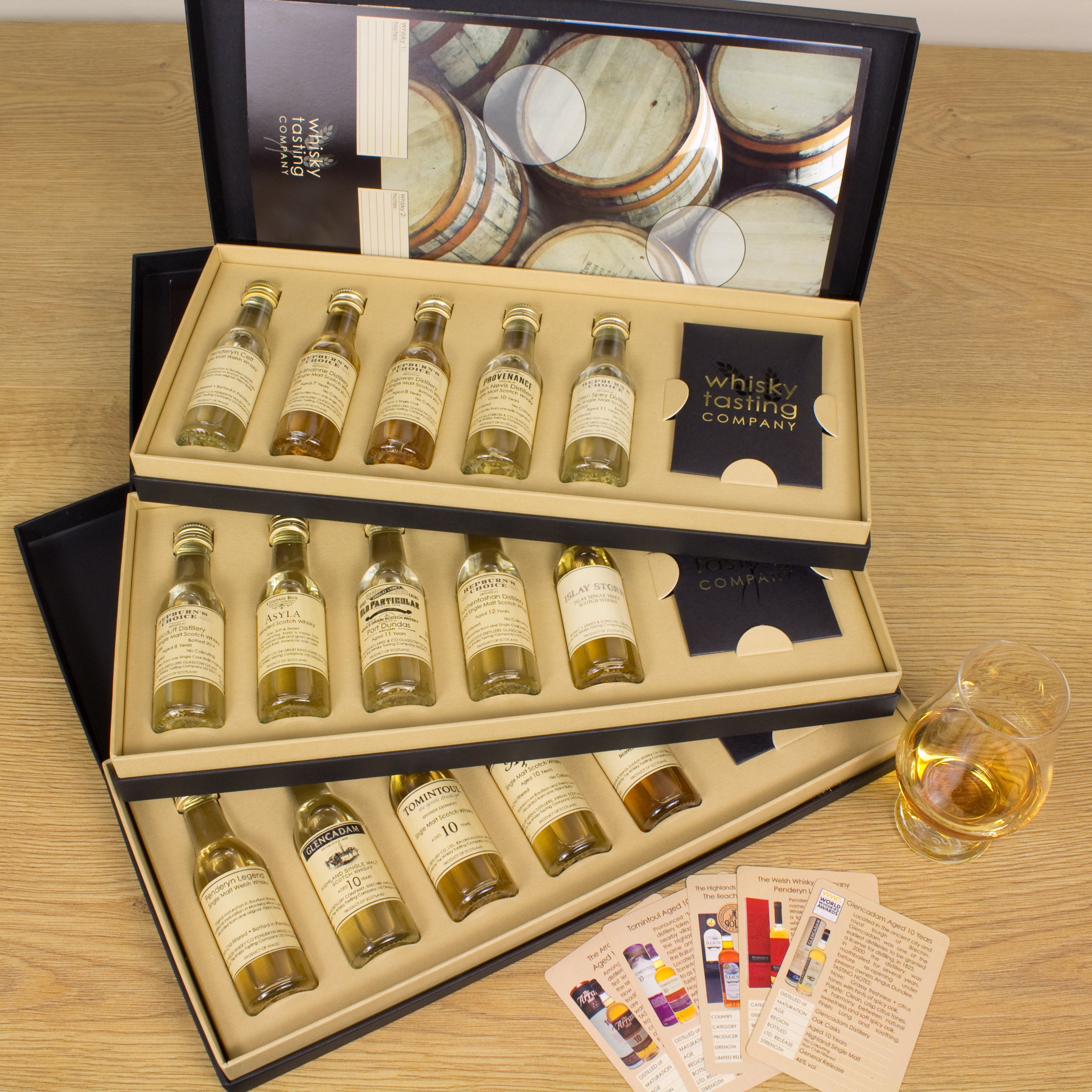
Our whisky tasting sets allow you to do that from home. Each one comes with five delicious miniature drams, matching tasting cards, and a beautiful tasting mat. You can enjoy an immersive tasting session without committing to a full bottle.
Plus, it’s a more relaxed way to learn what you like at your own pace. If you like what you see, you can keep the fun coming with a whisky-tasting subscription.