


Is it whisky or whiskey?: Why it matters

If you’ve seen ‘whisky’ and ‘whiskey’ used a lot within the whisky community, you’re probably wondering why there are two different spellings and whether that actually points to a distinction between the two.
The good news is that both spellings are correct. Today, ‘whisky’ and ‘whiskey’ are often used interchangeably, but they both have sprouted from different roots.
While the spelling 'whiskey' originated in Ireland, "whisky" was adopted by the Scots and has become one of the most popular spellings for the famous drink worldwide.
But why is this? And does it matter which spelling you use? Today, we’ll take a look at the history of these spellings and why each one survived centuries of whisky production.
Key takeaways
- ‘Whisky’ is generally used for Scotch, Japanese, Canadian, Welsh and English whisky.
- ‘Whiskey’ is generally used for Irish and American whiskey.
- The spelling reflects history, heritage, and regional convention, rather than one version being more correct than the other.
- Spelling can give you a clue about origin, but it does not guarantee flavour, as the taste depends on the grain, cask, maturation, distillation style, and blending choices.
- The safest rule is to follow the label, as some countries and brands have exceptions, especially in America, where both 'whisky' and 'whiskey' can appear.
Why are there two spellings?
Both 'whisky' and 'whiskey' come from the same linguistic roots, but their spellings developed differently across countries, traditions, and whisky-making cultures over time.
The word itself comes from the Gaelic word for 'water of life’, which is ‘uisge beatha' or 'usquebaugh'. Over the centuries, that phrase was shortened and anglicised into the word we now know as whisky or whiskey.
Therefore, the modern spelling difference is more about regional convention than the drink itself, as confirmed by The Scotch Whisky Association. While the two spellings are used to explain variations of the drink, there’s no actual set definition for what whisky is.
Since the legal definition is governed by the national and regional regulations of where it’s produced, different whiskies have to meet different requirements from where they’re from to be legally sold as whisky.
So a Scotch whisky differs greatly from a Tennessee whisky, and each country must respect the rules of how they’re made when sold internationally under international trade agreements.
A little additional fun fact for you there!
The Scottish spelling: whisky
In Scotland, people spell whisky without the ‘e’. That’s why you’ll always see Scotch whisky written this way, whether you are looking at a single malt, a blended Scotch, a smoky Islay dram, or a lighter Speyside style.
Here, the spelling is not just a stylistic choice, but it’s a part of the identity of Scotch itself. Since Scotch whisky is a protected product, it must be made in Scotland and matured in oak casks for at least three years.
So, when you see the words 'Scotch whisky' on a label, that spelling is tied to a very specific whisky-making tradition. The spelling also reflects Scotland’s long-standing influence on the wider whisky world, since many countries that took inspiration from Scottish whisky-making adopted the same spelling, including Japan, Canada, England, and Wales.
Why Japan, Canada, and much of the world use 'whisky'
In Japan’s case, the ‘whisky’ spelling is often associated with the country’s strong historical ties to Scotch whisky-making, as they were inspired by Scottish distillation methods, such as the use of copper pot stills and careful cask maturation.
Many people are surprised that Canada adopted the ‘whisky’ spelling since it’s produced in North America, but that goes to show that spelling follows tradition rather than geography alone.
That’s because Canada embraced the blending of pot- and column-distilled whisky, since early Canadian whisky distilleries were run by many British loyalists who brought this new process with them.
The Irish spelling: Whiskey
The Irish took a different path, differentiating themselves from Scottish whisky with the extra “e”, and that spelling is now the familiar convention for Irish whiskey.
While the extra letter may seem small, it carries a lot of history. In the 1800s, Irish and Scottish distillers were not only making different styles of spirit; they were also competing for reputation, quality, and recognition.
Irish whiskey was a major force in the global drinks trade at the time the “e” became one way to separate itself from the Scots. The Irish were so set on distinguishing themselves after they fought with the Scots over a new distillation process they had introduced to the scene.
While the Scots advocated continuous distillation using column stills, the Irish wanted to stick to their beloved pure pot-still whisky process, leading to a legal dispute over what whisky is and how it should be made.
The Irish spelling also had a major influence on America, as Irish immigration helped carry the 'whiskey' spelling across the Atlantic, which is why American styles such as bourbon whiskey, rye whiskey, and Tennessee whiskey are usually written with the “e”.

Why America usually uses 'whiskey'
Since Irish immigration brought whiskey over to America and made it popular, Americans largely follow the Irish spelling.
However, it gets a bit tricky, as not every American whiskey includes the ‘e’. That’s because under US regulations, the word may be spelt as either ‘whisky’ or ‘whiskey’ on labels, so distillers have a choice.
So, if you come across a whisky spelt with or without the ‘e’ while travelling in America, it doesn’t mean the former is Irish, and the latter is Scotch; it’s just a matter of preference.
Does the spelling tell you how it will taste?
While the spelling can definitely hint at where the whisky has come from, you won’t be able to know whether it’s smoky, smooth, sweet, spicy, or rich from that alone.
The flavour depends on the grain, cask, distillation style, maturation, climate, and blending choices, so Scotch whisky can be peated and smoky or light, fruity, and floral.
Irish whiskey also has a reputation for being smooth, but there are richer, spicier, and more complex Irish styles too.
Which spelling should you use?
If you clicked on this blog, it’s probably because you want to know which spelling you should use yourself.
While there’s no ‘better’ or ‘right’ way of spelling whisky, it’s normal to want to stick to tradition and feel like you’re not offending anyone by refusing to use their spelling.
So, if you want to seem like you know what you’re talking about at your whisky tasting nights, here’s a quick way to decide which spelling to use:
Use “whisky” when…
- talking about Scotch
- talking about Japanese, Canadian, English, or Welsh whisky
- When writing or talking about whisky from a UK point of view
Use “whiskey” when…
- talking about Irish whiskey
- talking about most American whiskey
- referring to a brand or label that uses that spelling
So, does it really matter?
All in all, if you’re an avid whisky drinker and you love to delve into the history behind what you’re drinking and abide by old-timey rules, then yes, we’d say it does matter what spelling you use.
After all, each spelling reflects different histories, origins, and traditions, so a lot more has gone into the distinction than someone deciding to add or take away an ‘e’.
However, it doesn’t tell the whole story, so if you want to really understand the difference between them, so you know WHY you’re using the different spellings, take the time to taste different styles, compare the labels, and notice how grain, cask, age and place shape the flavour in your glass.

Go on… indulge yourself
Luckily, we provide the perfect opportunity for you to do so at Whisky Tasting Company.
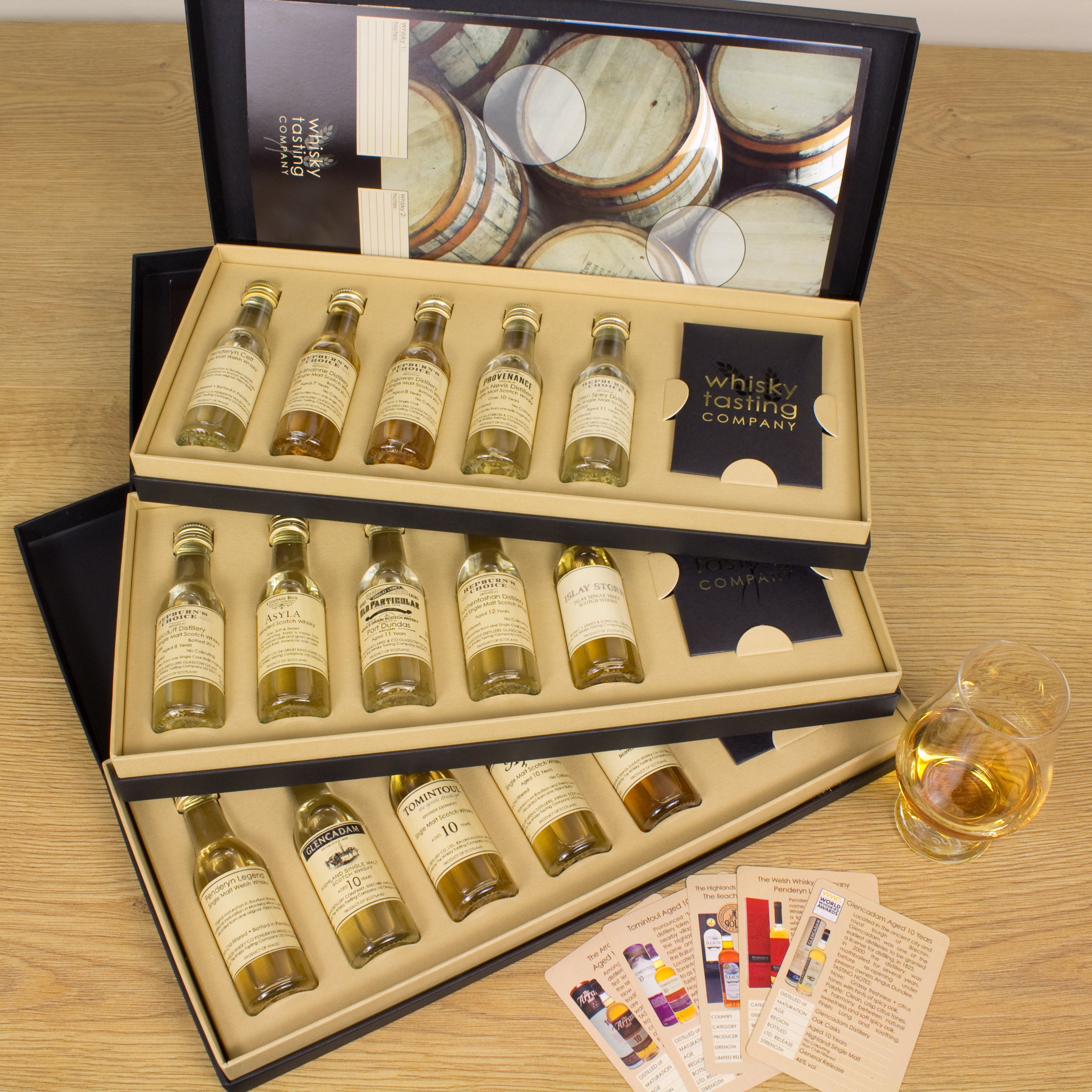
Our tasting sets provide you with an excuse to have a night in and indulge in your favourite drink from home, either sipping and tasting new whiskies alone or with friends and family.
Browse our whisky tasting sets today to discover your next favourite dram.