



A beginner's guide to Japanese whisky

If you love a bottle of Japanese whisky after a long day, then you’re someone who can appreciate the floral notes and understand the layers of a dram from Japan.
However, if it’s your first time trying out japanese whisky, you may be overwhelmed by the unfamiliar distilleries and different styles, which is completely normal.
Behind every Japanese whisky is a story, one that leads back to the origin of Japanese whisky and when and where it was first made.
That’s why we’re taking a deep dive into the history of Japanese whisky, covering its path to global popularity and how its famous characteristics have survived modern-day production.
We’ll also cover where it came from and the different flavours that come with it, so you can walk into your next whisky tasting with some new fun facts to dish out.
Key takeaways
- Japanese whisky was heavily influenced by Scotch whisky-making.
- There isn't one single Japanese whisky flavour; styles range from delicate and fruity to rich and smoky.
- Genuine Japanese whisky now has clearly defined industry production and labelling standards.
- Shinjiro Torii and Masataka Taketsuru played a major role in establishing Japan’s modern whisky industry, including creating Yamazaki and Nikka.
- Cask choice has a major influence on flavour, with ex-bourbon, sherry and Japanese Mizunara oak creating very different characteristics.
- Suntory and Nikka remain two of the best-known producers, alongside newer names such as Akkeshi, Sakurao, and Mars Whisky.
What is Japanese whisky?
Japanese whisky is, of course, produced in Japan, using malted grain and other permitted cereals, with production, maturation and bottling taking place under the Japanese whisky industry’s current labelling standards.
Though its origins are heavily influenced by Scottish whisky making, Japanese whisky is a category rather than a style. Japanese distillers developed their own approaches to distillation, blending, and maturation, turning a popular drink into something unique, with many regional variations.
So while whisky from Japan is often labelled as having light, floral notes and a delicate and smooth feel, it can actually include the following:
- Grain whisky
- Single malt whisky
- Blended whisky
- Light, fruity and floral styles
- Richer, oak-led expressions
- Smoky and peated whiskies
What makes a whisky Japanese?
Going back to our point about Japanese whisky labelling standards, there are now certain standards that a whisky has to meet in order to be classified as ‘Japanese’ whisky.
These are put in place by the Japan Spirits & Liqueurs Makers Association's labelling standards and are as follows, in no particular order:
- Malted grain must be used (although other cereal grains can also be included).
- The water used to make the whisky must be extracted in Japan.
- Saccharification, fermentation, and distillation must take place at a Japanese distillery.
- The spirit must be matured in Japan for at least three years in wooden casks with a maximum capacity of 700 litres.
- The spirit must then be bottled in Japan at an alcohol strength of at least 40% ABV.
The standards were announced in 2021, with a transition period that ended in 2024, meaning association members now have clearer rules about which products can be presented as Japanese whisky.
However, these standards aren’t legally binding in the same way as the legal protections around categories such as Scotch whisky. They’ve been put in place to help people understand what ‘true’ Japanese whisky is, giving buyers and sellers more transparency.
A brief history of Japanese whisky
One of the newest forms of whisky, Japanese whisky has been around for about 100 years, so not quite as long as Scotch whisky, which is 500 years old!
The story really begins in the early 20th century, when a small number of pioneers set out to learn traditional Scottish whisky-making techniques and adapt them to Japan.
Two names in particular shaped what Japanese whisky would become: Shinjiro Torii, the founder of the company that became Suntory, and Masataka Taketsuru, a Japanese chemist who travelled to Scotland to study whisky production first-hand.
The Scottish roots of Japanese whisky
In 1918, Taketsuru travelled to Scotland, where he studied chemistry before seeking practical experience at Scottish distilleries, including Longmorn Distillery in Speyside, where he learnt about malt whisky production.
He also gained experience with grain whisky and blending, and he recorded everything he learnt in his notebooks, later known as the Taketsuru Notes, which helped him bring that knowledge back to Japan in 1920.
By seeing how the Scots used malted barley, copper pot stills, and maturation in wooden casks, you can see how this influenced the start of whisky-making in Japan.
However, as more distillers emerged in Japan, they began developing their own production styles, flavours, and blending traditions, building on what they learned from Scotland.
Shinjiro Torii and the birth of Yamazaki
While Taketsuru was developing his technical knowledge, entrepreneur Shinjiro Torii had his own ambition: to create whisky in Japan that suited Japanese tastes.
Torii founded Kotobukiya, the business that would eventually become Suntory, and recruited Taketsuru in 1923 to help turn that ambition into reality. The pair worked together to establish Yamazaki Distillery, with construction beginning that same year near Kyoto.
This became Japan's first malt whisky distillery and is widely considered the birthplace of the country's modern whisky industry.
Masataka Taketsuru establishes Nikka
Besides their success, Torii and Taketsuru didn't ultimately share exactly the same vision for Japanese whisky.
Taketsuru long believed that Hokkaido's cooler northern climate offered conditions closer to those he'd experienced in Scotland and thought the whisky should be made there.
After leaving Kotobukiya in 1934, he established Dai Nippon Kaju in Yoichi, Hokkaido, which would later become Nikka Whisky. Because whisky must mature for years, the company initially produced apple products while its spirit aged.
Taketsuru's first Nikka Whisky was released in 1940, and the brand has since become a major part of the Japanese whisky industry.

How is Japanese whisky made?
The Japanese whisky distillation process is similar to the Scotch whisky process, the main difference being that Japanese whisky is made with a higher percentage of malted barley.
In fact, Japanese producers are particularly known for creating a variety of spirit styles within their own distilleries, giving their blenders plenty of different flavours and characteristics to work with.
1. Choosing the grains
The key ingredient is malted barley when it comes to malt whisky. The barley is allowed time to germinate, activating enzymes that will later help convert its starches into fermentable sugars.
Japanese grain whisky can also use other cereals, such as corn or wheat, alongside malted grain. Some also use peated barley for an earthy, smoky taste.
2. Mashing the grain
The malted barley is milled into a coarse flour called grist and combined with hot water in a mash tun, allowing enzymes to break down starches and release fermentable sugars into the water.
The sweet liquid produced from this is called wort. The spent grain is separated from the wort, which then continues to fermentation.
3. Fermentation
Next, the wort is transferred into fermentation vessels, often called washbacks, and yeast is added to feed on the sugars in the wort.
This produces alcohol along with many aroma and flavour compounds, and what’s left is a low-strength alcoholic liquid commonly known as the wash, which typically reaches around 7–7.5% ABV before distillation.
How long it ferments, the type of washback, and the yeast strain used all affect the final taste.
4. Distillation
Distillation concentrates the alcohol and refines the flavours.
Malt whisky is generally distilled in copper pot stills, where the wash is heated, causing alcohol and other volatile compounds to evaporate before being condensed back into liquid. This process is usually done twice.
The first run produces a stronger liquid, while the second lets the distiller separate it into different portions, selecting the desirable middle section, also known as the heart, for maturation.
How casks shape Japanese whisky
Much of a whisky's final character actually develops during the maturation process.
That means that the type of cask it’s placed in plays a huge role in the overall character of the whisky, from its flavour profile to its mouthfeel.
Japanese whisky producers use a wide range of casks, including ex-bourbon barrels, sherry casks, and Japanese Mizunara oak, each bringing something different to the game.
- Ex-bourbon casks: For Japanese whisky, ex-bourbon casks can contribute flavours such as vanilla, honey, caramel, coconut, and light oak spice.
- Sherry casks: These produce a noticeably richer style of whisky, bringing flavours such as dates and figs, dark chocolate, clove, cinnamon, rich oak spice, nuts, and raisins or sultanas.
- Mizunara oak: The cask mostly used for Japanese whisky; these are famous for their distinctive aromas and are associated with notes like sandalwood, coconut, incense, cedar, sweet wood, and aromatic spice.

Japanese whisky brands and distilleries worth knowing
Suntory and Nikka remain hugely important names in the Japanese whisky world, but a new generation of producers and distilleries has emerged, including Akkeshi, Sakurao, and Mars Shinshu.
Suntory
If there’s one name you're likely to come across when looking for Japanese whisky, it's Suntory.
Founded by Shinjiro Torii, Suntory established Yamazaki in 1923; it now has three big whisky distilleries: Yamazaki, Hakushu, and Chita. Some of Suntory's major whisky names include:
- Yamazaki
- Hakushu
- Chita
- Hibiki
- Kakubin
Nikkia
As we've already covered, Taketsuru studied whisky-making in Scotland before returning to Japan and eventually establishing his own company.
Nikka's two principal malt whisky distilleries are Yoichi in Hokkaido and Miyagikyo in Miyagi Prefecture, with a blend of flavours.
Yamazaki Distillery
Established in 1923, it was Japan's first malt whisky distillery and remains one of the country's best-known whisky names.
It produces a wide range of whisky styles, including fruity, sweet, and spicy characteristics, alongside influences from American oak, Spanish oak, and Japanese Mizunara oak.
Hakushu Distillery
Established in 1973 in the forests of the Japanese Southern Alps, this distillery is famous for whiskies with fresher, greener, and gently smoky characteristics.
You may come across notes such as herbs, citrus, orchard fruit and light smoke.
Chita Distillery
This distillery specialises in grain whisky and is located on the Chita Peninsula,
It produces different styles of grain spirit used in both Suntory blends and its own grain whisky expressions, with sweeter, softer profiles. In fact, Suntory describes Chita as an important component in blends such as Hibiki.
Yoichi Distillery
Yoichi was Taketsuru's first distillery and remains one of the most recognisable names in Japanese whisky. It uses direct coal-fired pot stills, a technique rarely seen in modern whisky production.
Nikka describes Yoichi's malt as bold and full-bodied, with richness and depth alongside a traditional peated component.
Miyagikyo Distillery
Miyagikyo was established in 1969 to give Nikka a contrasting malt whisky style.
While Yoichi tends toward a heavier character, Miyagikyo uses different still designs and steam heating to create a spirit that Nikka describes as softer, floral, and fruity.
Mars Whisky
Mars Whisky is produced by Hombo Shuzo, a company with a whisky-making history stretching back to 1949.
Today, it produces malt whisky at two different sites: Mars Komagatake Distillery in Nagano and Mars Tsunuki Distillery in Kagoshima, making for an interesting operation.
Akkeshi Distillery
For drinkers interested in smoky whisky, Akkeshi Distillery is another name worth remembering.
Located in Hokkaido, Akkeshi produces both single malt and blended Japanese whiskies, with many releases named after the 24 traditional Japanese solar terms. They tend to lean toward more peaty, robust, maritime flavours.
Sakurao Distillery
Based in Hiroshima Prefecture, this distillery produces the Sakurao and Togouchi single malt ranges, drawing on Hiroshima's contrasting maturation environments.
It also produces Togouchi Blended Japanese Whisky, combining malt and grain whiskies distilled and matured by Sakurao.
Try one of our Japanese whisky tasting sets today!
If you want to understand more about Japanese whisky, the best way to do so is to give it a try for yourself.
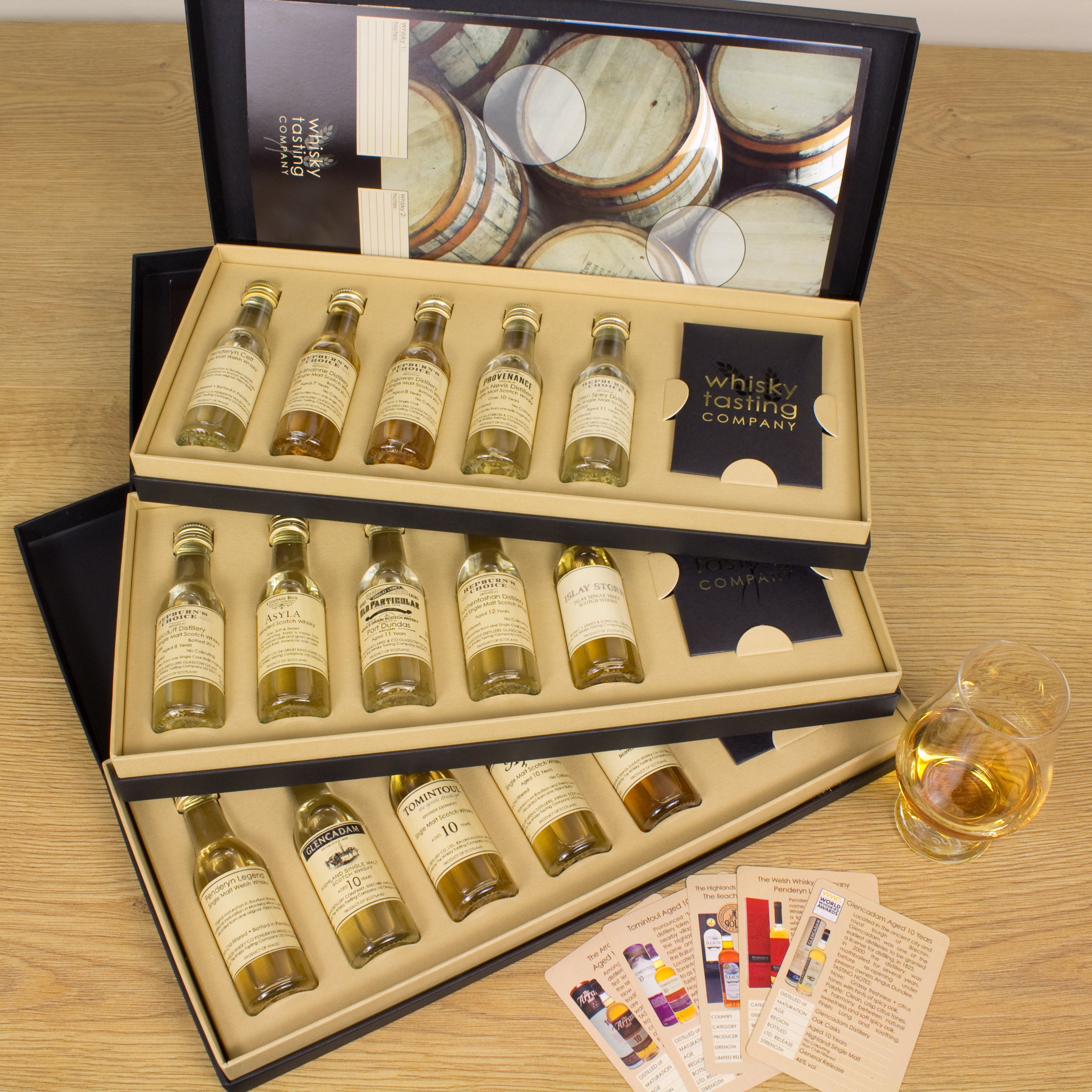
You’ll find that you learn a lot about something by indulging in it! Our Japanese whisky tasting sets let you do just that, with five bite-size bottles to test and compare.
Each tasting lets you explore the aromas, flavours, and characteristics that make Japanese whisky so distinctive, all from the comfort of home. Explore our sets today to find something that tickles your fancy.